By Kyna Morgan
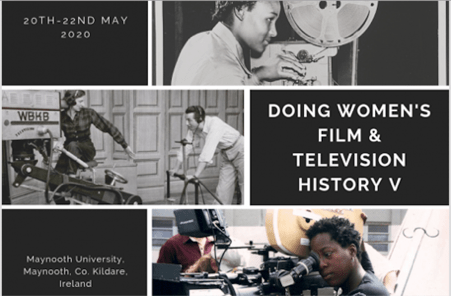
DWFTH 5 took place on 10th-11th July 2021 via Zoom. The conference was originally scheduled for May 2020 at Maynooth University, Ireland, but was cancelled due to the Covid-19 pandemic. You can see the full conference programme and paper abstracts here.
One of the great benefits of attending a conference is the ideas sparked within you that inflict a sense of urgency. The theme of this year’s DWFTH conference, ‘Histories of Women in Film and Television: Then and Now’, focused on the urgency with which women’s film and television history must be treated in current and ongoing scholarship, curation, and practice.

Of 28 panels offered, I attended 10 as well as other engaging events (Mary Harrod’s book launch, and more). Each panel began on schedule allowing ample time for brief paper summations and thought-provoking Q&As. The active support team and overall organisation of the event by Sarah Arnold and DWFTHN team were commendable. The launch of RAMA (Research Network on Audiovisual Made by Women in Latin America) was particularly exciting, although the attendance was small; an active group with a clear remit to further research in this field, I hope other such groups will receive more attention in future.
The international participation was energising. Hearing from scholars and practitioners from around the world as we collectively write women (back) into the global film and TV canon and annals of history was stimulating. My primary historical research has been on African American women filmmakers in silent and early sound cinema (published in the Women Film Pioneers Project) [1]. I was gladdened that several presentations featured research on African American and diaspora women filmmakers and performers and hope to see more of those at future conferences. This is a crucial historiographic omission within women’s film and TV history scholarship that deserves more reparative attention. The conference should remind us that marginalised perspectives deserve active inclusion, and that new and alternative ways of thinking about, and theorising, women’s film history can help to ‘unsettle and challenge common assumptions’. (Foss and Ray, 1996, p. 253)
The following is a brief connective review of four presentations I found particularly essential:
Karen Pearlman (‘Distributed authorship: The “et al.” theory of creative practice, distributed cognition, and feminist film histories’ / panel: ‘Challenging the Author’s Cinema’) proposed an ‘et al’ credit and citation for film that eschews the notion of the auteur as it affirms the contributory nature of filmmaking. Theorising filmmaking as a process of ‘distributed cognition’, one in which everyone who contributes is a creator, helps with defining film labour in more holistic and accurate terms.
Isabel Seguí and Lorena Cervera’s presentation, ‘#PrecarityStory (2020): Feminist film researchers making Third Cinema in contemporary UK’ (panel: ‘Film, Television, and Women’s Activism’) discussed the co-creation aspects of their documentary film as well as the positionality of documentary filmmakers. The term ‘extractivist’ was invoked in reference to a type of relationship that higher class status filmmakers can have with working class or subaltern subjects; in their film, this hegemonic model of documentary filmmaking was collapsed.
In ‘Women on the frontline: Collecting visible evidence on domestic abuse in the midst of a pandemic’ (panel: ‘Practice as Research’), Eylem Atakav highlighted the importance of practice as research by ‘doing women’s history in the present moment’, as well as the ‘need to respond [and to] become agents of change’. Her documentary film was her practice that resulted in research which then had a tangible, material impact on policy around the domestic abuse support sector in the UK.
Finally, Jemma Buckley, Selina Robertson, and So Mayer discussed in ‘REVOLT, SHE SCREENED: Curating feminist film history, screening the history of feminist film curation’ (panel: ‘Film Curations, Clubs, and Catalogues’), how their 2018 film tour was fueled by the spirit of 1968. Through their curation, they recovered numerous film works by women which then sparked discussion and debate in venues across the UK, but also demonstrated how film curation can be understood as a feminist practice.
I find that each of these presentations and the ideas, theories, and methodologies they propose and employ, can be a connective tissue that brings together the ‘then and now’ of women’s labour in film and television. An expanded perspective on filmmaking as a contributory process through a ‘distributed cognition’ helps us understand the practice of co-creation and a collapsing of a hierarchy of creation and direction. This ties in directly with a filmmaker-subject co-creation practice in an anti-extractivist framework, eliminating class barriers and hegemonic structures. These conditions of equity- and equality-oriented production models demonstrate how filmmaking labour can help create research, respond to the current moment through practice, and show how filmmaker-academics can serve as ‘agents of change’. The final piece of this four-part mosaic is a curatorial model of activist feminist scholarship which writes women back into history through the curation of women’s work and its recovery from the archives (although this process includes hidden labour that deserves recognition). With ‘film history [being] created and remembered’ (Selina Robertson 2021), it is clear that curation is both contributory and practice-based, a ‘feminist practice’ of resistance and revolt.
Footnotes
1 See ‘African-American Women in the Silent Film Industry’ https://wfpp.columbia.edu/essay/african-american-women-in-the-silent-film-industry/, and entries on Eloyce King Patrick Gist, Eslanda Robeson, Alice B. Russell, Tressie Souders, and Maria P. Williams which are also found on the Women Film Pioneers Project website.
Kyna Morgan will enter the Research PhD in Film & TV Studies programme at the University of Glasgow in Autumn 2021. Her research will focus on film festivals as sites of discursive cultural intervention around issues of inclusive representation and cultural identity. She holds an MA in Global Film and Television from the University of Hertfordshire, and her published research is found in the Women Film Pioneers Project.
 WFTHN
WFTHN 
One response to “DWFTH 5 (2021): Conference Report and Presentation Connections”
[…] DWFTH 5 (2021): CONFERENCE REPORT AND PRESENTATION CONNECTIONS. 13/08/2021 […]