
by Stefania Marghitu
This blog first appeared on the Critical Studies in Television website on 3 December 2015.
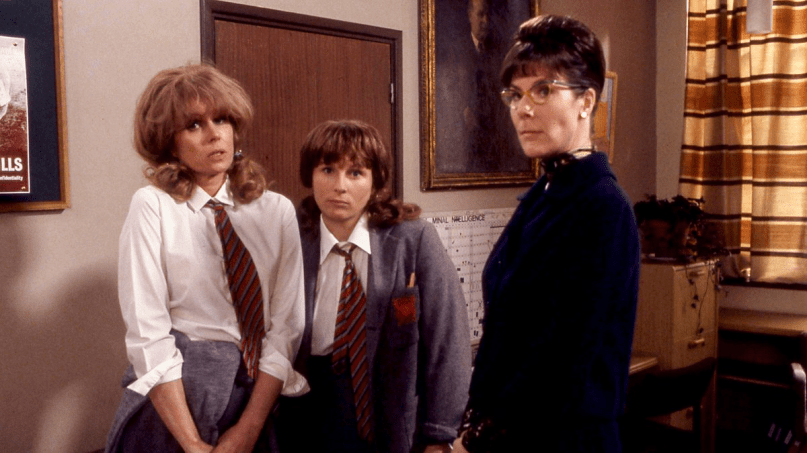
I’ll always remember my initial reaction when I first watched Absolutely Fabulous (BBC, 1992-2012). Edina Monsoon (played by co-creator Jennifer Saunders) and Patsy Stone (played by former model and co-star Joanna Lumley) appeared to be the rudest, crudest and strangest women I ever saw on television. It was around 1998; I was about ten years old growing up in the U.S., and I found it through some kind of VH1 marathon re-run special, binge-watching in one of its earliest forms. Watching Ab Fab as a ten-year-old kid was also the first time I remember being upset and perplexed while watching a TV series. The program stayed in my memory, but it wasn’t until my late twenties that I understood being offended, appalled, and confused was exactly what Saunders intended for her project. When I re-visited Ab Fab 17 years later, I recognized my initial assessment was not wrong but that this was what made the show so right.

The episode that I remember most vividly is “Iso Tank” (Episode 4, Series 1, 1992), in which Edina adopts a Romanian orphan to infuriate her precocious yet sartorially challenged teenage daughter Saffron “Saffy” Monsoon (Julia Sawalha). In her failed adoption attempt, Eddy tries to gain attention from anyone and everyone, while Saffy is constantly embarrassed. I could not understand why or how a mother could be so narcissistic, so selfish, and so very drunk. I do recall enjoying the physical slapstick-style humour of Eddy and Patsy because it reminded me of Lucille Ball, my and everyone else’s favourite Nick at Nite star at the time.
Of course, my assessment as a kid was going to evolve. But my initial reception makes so much sense now: in the U.S., audiences are less likely to watch a series with “unlikeable” characters. American audiences even cheer on anti-heroes and anti-heroines – they are the unexpected protagonists – from Don Draper of Mad Men to Nancy Botwin of Weeds. Some comedies like Seinfeld and It’s Always Sunny in Philadelphia have achieved in showing horrible people as protagonists, yet audiences still cherish them. As someone who grew up in the U.S., I also cherish my favourite TV characters, including Eddy and Patsy. But never as role models.
American narratives ultimately still strive for a Hollywood-influenced sense of redemption and closure at the end of a series run. We don’t know what happens to Tony Soprano as the last scene in the series fades to black, but we last see him with his family, content in a diner. Tony, played brilliantly by the late, great James Gandolfini, embodies the loveable gangster: he lied, cheated, and stole throughout The Sopranos’ eight-year run on HBO. We see this need for likeable protagonists best in American adaptations of British shows like The Office (BBC, 2001-2003; NBC, 2005-2013). Ricky Gervais’ David Brent was rude, crude and totally insufferable, whereas Steve Carell’s Michael Scott was fatally flawed yet hopelessly endearing. I have briefly touched upon the transatlantic divide between the reception of sympathetic characters in an article on Girls. My co-author Conrad Ng and I also cite an apt article written by Sarah Hughes of The Independent, who explains these differences in terms of gendered expectations as well as US/UK disparities.
This likeability component, however, is only secondary to what I believe my biggest discovery was upon watching Ab Fab again: the series is a complete mockery of the self-obsessed, consumer-driven, pleasure-seeking archetype of the contemporary woman in both the U.K. and the U.S. We don’t cheer on Eddy and Patsy to get through the fashion show, trip to Morocco, or new business venture with Minnie Driver. Ab Fab makes fun of, critiques and questions the PR lifestyle in sharp contrast to a series like the oft-cherished and maligned Sex and the City (HBO, 1998-2004), in which Carrie Bradshaw (Sarah Jessica Parker) and company were ultimately portrayed as likeable, somehow relatable role models that young women in the U.S. sadly emulated. Although Ab Fab‘s beginning predates Sex and the City by six years, it somehow foreshadows the culture surrounding it and criticizes it ahead of time. All of the same tropes are evident in both series. They centre on women working in fields focused around the intersection of art and commerce, consumerism and pleasure. They are single (divorced or never married). They live in major capital cities. They are uncertain of their futures. They are utterly terrified of getting old. They love to shop until they max their credit cards, drink until they blackout, smoke until their lungs can’t take it anymore, diet until they reach new levels of eating disorder, pamper until their masseuse, facialist, or manicurist can’t take it any longer and cleanse out all the toxins just to alleviate the anxiety and existential dread.
Saunders may not have entirely foreshadowed the impact and popularity her series or Sex and the City would have, but her interviews suggest she was tapping into a very specific kind of woman and experience of the time and of the place: the PR professional in London in the early ‘90s.
In a 2011 featurette that looks back on the series, Saunders explains the Ab Fab origin story:
In 1992, Dawn [French, her comedic partner and peer in her comedic genius] was having a break, but a nice man at the BBC [Jon Plowman, Producer, Absolutely Fabulous] let me have my own show!
And it was at this time that we were becoming very aware of PR. PR was into everything. And so there was fashion PR, there were launches, red carpets. Combine that with bad parenting, cruelty, alcohol and fags, and you’ve got a sitcom!
Ruby Wax (actress and script editor for Ab Fab) recalls that this PR woman needed to be made fun of – and brutally – onscreen. This is precisely what the show did.
Stefania Marghitu is an assistant professor of film and television in the Department of Journalism and Creative Media at the University of Alabama. She is the author of the book Teen TV (Routledge TV Genre Guidebooks, 2021). She has published work in journals such as Feminist Media Studies, New Review of Film and Television, Communication, Culture and Critique, and edited collections such as White Supremacy in the American Media and ReFocus on Amy Heckerling. She received her PhD from the University of Southern California’s Division of Cinema and Media Studies in 2020 and has previously taught at Pitzer College, Chapman University, California State University Northridge and Loyola University New Orleans. She is currently working on a book manuscript on women showrunners in US network TV.
 WFTHN
WFTHN 