By Selina Robertson and Isabel Moir
“Something of an alchemist in film direction, Stephanie Rothman was able to turn the base metal of trashy low-budget cinema into pure gold.”’” – Bev Zalcock, June 2024.
As we, Selina Robertson and Isabel Moir, write this blog post, American film director Stephanie Rothman is a guest of Il Cinema Ritrovato Festival. At the age of 88, Rothman has been invited to Bologna to introduce the new 4K digital restorations of Group Marriage (1972) and The Working Girls (1974), which were overseen by Dave Kehr at The Museum of Modern Art (MoMA) in collaboration with Rothman. This year’s Il Cinema Ritrovato is concurrent with a resurgence of interest in Rothman’s work that has been underway since 2015. Feminist film scholar Alicia Kozma has critiqued the “Rothman Renaissance … after forty years of neglect” as a situation which “highlights the problems with ahistorical recoveries of women filmmakers.”1 As feminists and film programmers who are conscious of the politics of archival (re)-discoveries and the impact that ahistorical revivals can have on filmmakers such as Rothman, we know that there is much to learn from Rothman’s story. During Rothman’s hazardous time in Hollywood, she encountered sexism, institutional barriers, discriminatory hiring practices, erasure, and neglect. Yet her films were also celebrated by women’s film festivals and theorised by critics such as Pam Cook in the 1970s.2 To that end, at Cinema Rediscovered this month, we will be launching a feminist curatorial initiative to bring these new restorations of Rothman’s films to U.K. audiences. To begin with, we will be presenting a new 35mm print of The Student Nurses (1970), courtesy of MoMA.
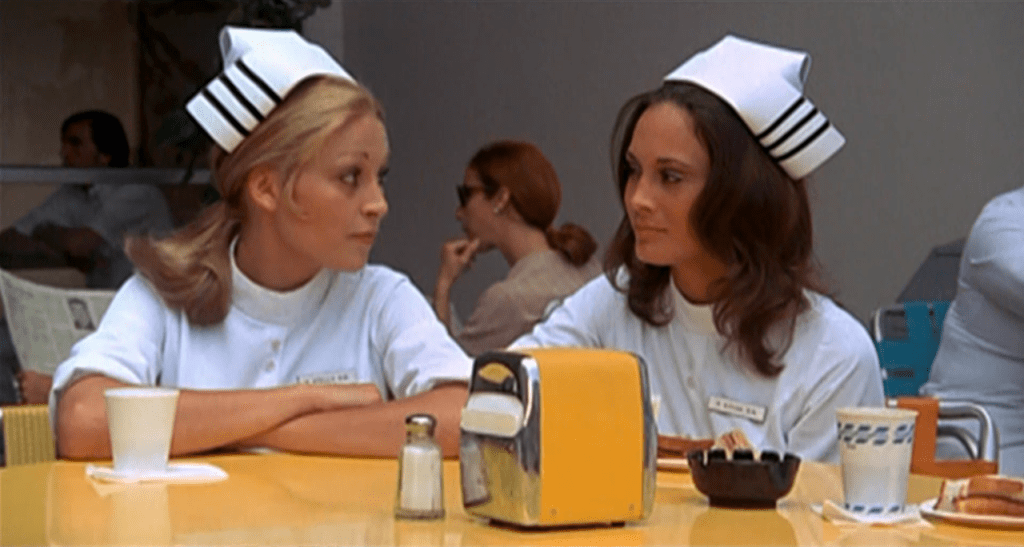
A graduate of the University of Southern California film school and the first woman to be awarded the Directors Guild of America student filmmaking fellowship, Rothman completed seven feature films between 1966-1974. Her filmmaking career began when she was hired to work assisting American producer and filmmaker Roger Corman. In 1970 Rothman wrote and directed The Student Nurses, the first in a popular cycle of exploitation films about nurses that others directed following Rothman’s lead. Despite working within the confines of the exploitation genre, Rothman introduced feminist ideas and subjects into her work. In 1972, after being overlooked to direct Boxcar Bertha (1972), a job Corman gave to Martin Scorsese, Rothman left to set up Dimension Pictures with her husband Charles S. Schwartz. At this company, she made three more films, Group Marriage (1972), Terminal Island (1973) and The Working Girls (1974), after which Rothman spent ten years trying to find work in mainstream Hollywood. Doors were kept shut and in 1984 she left the film industry.

Our programming initiative sets out to find Rothman in the archive, as well as to to recontextualise her films and ideas within the present moment and argue for her continuing relevance. In the 1970s Rothman’s films were screened at the Edinburgh Film Festival and programmed by Claire Johnston in her germinal 1973 women’s film season at the National Film Theatre.3 In the 1980s, her work was programmed by feminist collectives at the Rio Cinema in East London and at the Norwich Women’s Film Weekend. Her films were part of a dynamic feminist film culture that was being debated and constituted in the cinema. This was an era in which programmers and critics worked in and with archives, shaping the reception and circulation of an emergent feminist cinema. Rothman’s films were at the centre of feminist debate about what might constitute a new language of women’s counter-cinema, capable of confronting and parodying the patriarchal myths and stereotypes of mainstream Hollywood cinema.
In 1999, Feminale, the women’s film festival in Cologne, invited Rothman to the festival as its guest of honour. Organised by Verena Mund and Carla Despineux, Girls, Gangs, Guns – between Exploitation Cinema and the Underground was a celebration and exploration of exploitation cinema and the underground through a feminist lens. Guests included B. Ruby Rich, Pam Cook and Bev Zalcock, whose book Renegade Sisters: Girl Gangs on Film (1998) and personal contact with Rothman in London, was an influence on the organisers.
In recent years, there has been a renewed interest in Rothman’s films, with screenings taking place in venues including MoMA and The Spectacle Theatre in New York with Rothman in attendance. In 2023, the first of MoMA’s restorations The Working Girls premiered at the Venice International Film Festival. This was Rothman’s final film and the only one for which she is the sole credited writer. Additionally, in 2018 the Etheria Film Festival in LA, a global platform for new horror, comedy, science fiction, fantasy, action, and thriller films made by emerging women directors, created The Stephanie Rothman Fellowship for Horror Films, open to any identifying women in an undergraduate or graduate university or college film program around the world.

Isabel first discovered Rothman’s work in a special issue of Sight & Sound titled “The female gaze: 100 overlooked films directed by women,” which was published in 2015. The issue included contributions from filmmakers and critics, including writer and film scholar Virginie Sélavy, who chose Stephanie Rothman’s The Velvet Vampire (1971). The film is a subversive feminist take on the vampire genre, set in a sun-drenched L.A. desert where a beautiful, centuries-old vampire seduces a young married couple whose dream-inducing spell undermines their bond of heterosexual desire. It was clear the influence that Rothman’s films had had on other filmmakers still working today, most notably Anna Biller. This discovery led Isabel to programme The Velvet Vampire at the Overnight Film Festival in 2016, which celebrated repertory cinema and analogue formats. It was very exciting to see how audiences reacted during the screening, proving there was an appetite for her films. It was also clear that there was limited awareness of her as a filmmaker as well as opportunities to see her film in the U.K. Sharing this experience with audiences developed Isabel’s interest in screening and recontextualizing Rothman’s work for contemporary audiences. Inspired by Isabel’s experience of presenting The Velvet Vampire, in 2020 Selina included The Velvet Vampire in a season of feminist films at the Rio Cinema, as part of her practice-based research PhD . Yet, the screening never happened due to lockdown and the Rio closing.
Both self-proclaimed Rothman fans, Selina and Isabel have decided to collaborate on this new curatorial project to bring the new restorations of Rothman’s films to UK audiences. Interestingly or alchemically, our project’s plans coincided with MoMA’s work on restoring Rothman’s films, which produced new screening materials that was previously impossible to find. With our project, we hope to ensure that new audiences encounter Rothman’s distinctive, vibrant, and countercultural L.A-set films.
About us
Both self-proclaimed Stephanie Rothman fans, Selina Robertson (Birkbeck, Club des Femmes) and Isabel Moir (London Film Festival film programmer) have previously presented Rothman’s films via their own film programming practices. This collaboration marks the beginning of their feminist curatorial project to bring the new restorations of Rothman’s films to the UK, which they feel are ripe for discovery and appraisal. With thanks to Cinema Rediscovered for their support.
If anyone has any memories to share of programming or watching Rothman’s films at women’s film screenings and events in the UK during the 1970s, 1980s and 1990s, please get in touch at selina@clubdesfemmes and isabelmoir21@gmail.com.
Instagram: @isabel.moir @selinasue167
- Alicia Kozma (2023), The Rothman Renaissance, or the Politics of Archive (Re) Discovery. In: Women & New Hollywood: Gender, Creative Labour & 1970s American Cinema, edited by Aaron Hunter and Martha Shearer, pp: 17- 30. London and Oxford: Rutgers University Press. ↩︎
- Pam Cook (1976), ‘Exploitation’ films and feminism. Screen, 17 (2): 122-127. ↩︎
- Johnston’s curation of this women’s film season evidences feminist film programming as a critical and activist practice. See also Johnston (1973), Notes on Women’s Cinema. London: Society for Education in Film and Television. ↩︎
 WFTHN
WFTHN 
One response to “Programming the Films of Stephanie Rothman in the UK”
[…] and Isabel Moir. They have written about their experience with programming Stephanie Rothman for WFTHN. This essay by Anahit Behrooz was commissioned by Cinema Rediscovered, and is crossposted with kind […]