
My discussion of Christopher Nolan’s Oppenheimer focuses on the film’s title character and his relationship to two women, his wife Katherine (‘Kitty’) and his lover Jean Tatlock. Before saying more about these three, it is perhaps worth noting that the actors playing them are all from the British Isles, as are two other actors Nolan has used in several of his films (Kenneth Branagh is in three and Michael Caine in seven) as well as his Batman (Christian Bale) and, of course, (almost) the whole casts of the London-set Following and of Dunkirk, as well as about half of the cast of The Prestige, which is mainly set in London.
To some extent these casting decisions, where they are not primarily motivated by a film’s setting, are perhaps related to the fact that Nolan, while having an American mother and US citizenship, was born, raised and educated, and started to make films, in the UK (where he also has citizenship).
Nolan belongs to a long line of extraordinarily successful and influential Hollywood people with a British background, which includes, for example, Charles Chaplin and Alfred Hitchcock. It also includes actors who have played iconic Americans characters, ranging from Vivien Leigh’s Scarlett O’Hara and Lena Headey’s Sarah Connor (in the TV series Terminator: The Sarah Connor Chronicles) to Robert Pattinson’s (as well as, Christian Bale’s) Batman and Andrew Garfield’s as well as Tom Holland’s Spider-Man. As far as films about real people are concerned, there is, for example, Felicity Jones as supreme court judge Ruth Bader Ginsburg in On the Basis of Sex (2018) and Kate Winslet as photographer Lee Miller in Lee (2023) (and, on the fictional side, as Rose DeWitt Bukater in Titanic [1997]).
It is also worth mentioning that in recent years British actresses, with or without dropping their original accents, have been at the centre of several of Hollywood’s most important science fiction/fantasy franchises on the big and the small screen, including Kate Beckinsale in the Underworld movie series (2003-16), Daisy Ridley in the Star Wars sequel trilogy (2015-19), Emilia Clarke in Game of Thrones (2011-19) and Millie Bobby Brown in Stranger Things (2016 to date).

Starting with Black Widow (2021), Florence Pugh has joined the Marvel Cinematic (and Televisual) Universe as Yelena Belova (with a Russian accent), and she is also now part of the Dune franchise (with an American accent); she has played a range of American characters across her career. And Emily Blunt has been the focus of the first instalments of two action or science fiction mini franchises, Sicario (2015) and A Quiet Place (2018; Blunt also stars in the second movie in the series, but not in the third), playing Americans in both cases, also doing so in several other films.
Katherine Oppenheimer is in many ways an interesting character for her to play. Born Katherine Puening in 1910 in Germany, she came to the US at the age of two and later spoke both American English and German without a distinctive accent. She studied and travelled widely, was a political activist and had embarked on a scientific career as a botanist by the time she met Oppenheimer.
There is a lot of material on her in Kai Bird and Martin J. Sherwin’s 2005 Oppenheimer biography American Prometheus, on which the film is largely based. As with everyone else mentioned in this massive book, most of the material on Katherine Oppenheimer does not make it into the film. However, one does get the impression that Nolan’s approach was more reductive in her case than in the cases of many other people. One might say that the film mainly presents her as a serial monogamist, a former communist, a somewhat reluctant and perhaps incompetent mother, the unhappy (and yet deeply devoted) wife of an unfaithful husband and an alcoholic. In the film, as in life, she is referred to as ‘Kitty’, which might seem to belittle her, but it also sets up a delicious contrast with the way the film presents her as a rather difficult, obstreperous, tempestuous person; she certainly is no pet, no cute kitty-cat.
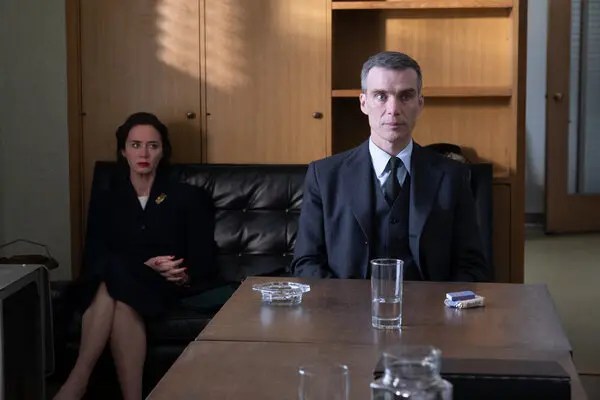
Despite her limited screen time, Kitty does have a strong presence. When the story properly gets started just over a minute into the film with Oppenheimer’s testimony at his 1954 security hearing, she is a small, shadowy, out of focus, somewhat ominous presence, sitting in the background behind Oppenheimer who faces the camera in close shots.
In later scenes from this hearing, she can be seen more clearly, especially when (at 31:47) Oppenheimer’s testimony turns to his relationship with his wife, which is also when she first appears in a flashback to pre-war events. During their first ever meeting (in 1939) Kitty makes a big impression on Oppenheimer (and, I would say, also on the audience), and it is arguably she who gets their romance going, partly by making dismissive comments about her current marriage (her answer to the question whether she is married is ‘not very’).
In a sense, her perspective on her husband’s testimony at the hearing takes control of its filmic depiction when (at 1:15:14) he talks about the end of his relationship with Jean Tatlock (in 1943). The audience knows that the relationship did not end when he married Kitty (in 1940); and it is easy to understand for viewers that her husband’s talk might be particularly difficult for Kitty to hear at this point. In the course of the testimony Oppenheimer is suddenly revealed to sit naked in his chair, and after a medium close-up of Kitty, a reverse shot reveals a nude Jean Tatlock straddling her husband, having sex and exchanging looks with Kitty, who eventually averts her eyes.
Kitty’s own testimony at the hearing (starting at 2:37:28) has been recognised as a high point of the film, and perhaps also of Emily Blunt’s acting career. There is a lot to be said about the transformation the character/performer undergoes during this testimony (from meek to masterful etc.), but I want to focus on what leads up to it: in preceding scenes Kitty aggressively demands that her husband should start fighting back, while Oppenheimer’s lawyer is so concerned about her alcoholism and her volatility that, when waiting for her late arrival at the hearing, he asks Oppenheimer: ‘Do you even want her here?’ Oppenheimer is absolutely confident that ‘she’ll do fine’.

One of the reasons for his confidence is the fact that ‘We’ve walked through fire together.’ While he says this (at 2:37:23), the film flashes back, just for a second, to a crucial moment in their relationship. Importantly, the scene containing that moment was first presented almost exactly halfway through the film’s story (excluding the credits, the story runs for just under 2 hours and 54 minutes); it takes place in 1944 and starts at 1:27:03.
I think it is highly significant that given the film’s split between events leading up to the first atomic explosion and events thereafter, one might expect the explosion to come at the story’s midpoint. But it is only shown later (at 1:55:48) and the midpoint instead belongs to an encounter between Kitty and her husband, and it revolves around Oppenheimer’s devastation after he has heard the news of Jean Tatlock’s suicide.
The film sets up this encounter by concluding the previous scene in his lab with an ominous statement made by his secretary: ‘There is a call… from San Francisco.’ Based on what we have seen and heard up to this point (and any prior knowledge of the historical events we might have), as an audience we can guess that this call concerns Jean Tatlock, and the news will not be good. So, what had been Tatlock’s appearances in the film so far? She first appears (at 22:10) when Oppenheimer meets her at a party (in 1936). A committed communist, Tatlock immediately challenges him about his politics and also flirts with him, with dialogue references to ideological ‘wiggle room’ leading straight into a sex scene, with Jean on top.
Apparently Oppenheimer is not quite up to it, so Jean dismounts and examines his book shelf, then gets on top of him again and asks him to read a specific passage from a book written in Sanskrit; what he then obediently translates into English is a version of the statement that Oppenheimer is most famous for (it is forever associated with his response to the first nuclear explosion; in the film this statement later reappears [at 1:57:20] as a voiceover – which actually is an aural flashback –, when Oppenheimer observes the explosion): ‘And now I am become death, destroyer of worlds.’ Their sexual intercourse is resumed. In many ways, these two and a half minutes are not just surprising, but disruptive, even transformative, both for Oppenheimer and for the film.
In later scenes it becomes clear that Tatlock is in two minds about her relationship with Oppenheimer. She does not seem to want a conventional relationship, but she does need him. After his marriage to Kitty and the beginning of the Manhattan Project (in 1942), Oppenheimer sees Tatlock one last time in San Francisco. Their meeting (which starts at 1:14:30) is intercut with Oppenheimer’s testimony about his relationship with Tatlock which I discussed earlier.
Here I need to add that in his testimony Oppenheimer refers to Tatlock undergoing ‘psychiatric treatment’, being ‘extremely unhappy’ and still in love with him, which is why he felt he had to see her one last time. In the flashback he tells her ‘I can’t see you again’. Tatlock asks (with a hint of barely suppressed panic): ‘But what if I need you?’ In his testimony, Oppenheimer declares that he never saw her again, this declaration being preceded by very brief cut-aways showing what are later revealed to be fragments of a scene in which Tatlock commits suicide (in 1944). This sets the stage for the ominous reference to the call from San Francisco (about ten minutes later, in screen time).

Back to the crucial scene which then starts at the midpoint of the film’s story: Kitty is riding across the forest looking for her husband. She finds him lying on the ground. He is barely able to explain himself. His hesitant utterances are intercut with shots of Tatlock taking pills, leaving a note and putting her head into the bathtub (with one brief shot showing her being pushed down by an unseen assailant; it is unclear what the status of this shot is, his imagination or historical reality). Oppenheimer feels responsible for her death and is wracked with guilt. Kitty pulls him out of his sorry state, reminding him of all the people (including, presumably, not only members of the Manhattan Project but also herself) who depend on him. The scene ends with a low angle shot of her figure towering over him.
This midpoint encounter is echoed in a later scene (starting at 2:49:47 and thus very close to the end of the story). It takes place soon after Oppenheimer’s security clearance has been revoked. Kitty (expressing an idea similar to comments made in the film by Oppenheimer’s chief opponent, Lewis Strauss, after his senate hearing) says: ‘Did you think that if you let them tar and feather you, they would would forgive you?’ After a pause, she adds: ‘They won’t.’ Oppenheimer calmly responds, with more than a hint of his old arrogance: ‘We’ll see.’
At the surface, this would seem to imply that, in Kitty’s view, Oppenheimer needs forgiveness for having overseen the creation of the atomic bomb and that he voluntary subjected himself to victimisation during the security hearing as a way to achieve this. But, as the film has made so abundantly clear, his relationship to the bomb is intimately connected to his relationship with Jean Tatlock (‘I am become death’ and all that) and thus to the guilt he felt (and perhaps still feels) about her death; arguably, he brought death to her as well as to the people in Hiroshima and Nagasaki.
Might one go as far as saying that the film’s (and Oppenheimer’s) vision of a nuclear fire spreading across the surface of the Earth at the very end of the story is an echo not only of the Trinity test and the Hiroshima bombing but also of Oppenheimer’s vision of Jean Tatlock’s death at its midpoint? However one answers this question, it is, I think, hard to deny the centrality of Jean Tatlock and Kitty Oppenheimer, of Florence Pugh and Emily Blunt to Christopher Nolan’s Oppenheimer.
Peter Krämer is a Senior Research Fellow in Cinema & TV in the Leicester Media School at De Montfort University (Leicester, UK). He also is an Honorary Fellow in the School of Media, Language and Communication Studies at the University of East Anglia (Norwich, UK) and a regular guest lecturer at several other universities in the UK, Germany and the Czech Republic. He is the author or editor of twelve academic books, including American Graffiti: George Lucas, the New Hollywood and the Baby Boom Generation (Routledge, 2023). For many years he has published about, and taught courses on, the role of women in Hollywood (both on and off screen).
 WFTHN
WFTHN 