From the Margins towards the Centre:
Women in 1970s and 1980s Hollywood:
Part 1 – General Trends
by Peter Krämer
This blog is based on a paper I presented at the second WFTHN international conference, “Doing Women’s Film and TV History”, in April this year. The paper used a range of quantitative indicators and a case study (see next week’s blog) to gauge the changing status of women in the American film industry between the 1960s and the 1980s. After reaching a historical low-point in the late 1960s and early 1970s, the position of women in Hollywood improved dramatically (though never coming even close to parity with men). This improved position was correlated with a return to prominence of what are traditionally regarded as female-oriented genres in the US box office charts and at the Academy Awards, and also with changes in the construction of gender roles in Hollywood movies.
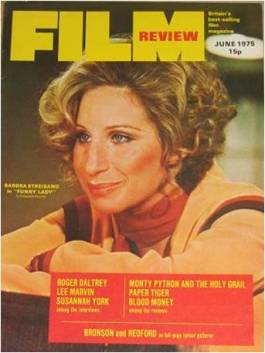 Every year Quigley Publishing asks exhibitors in the United States who they consider to be the top “money-making stars”. Throughout most of the 1960s, the top spot in their annual poll was occupied by a woman – initially Elizabeth Taylor and Doris Day, then Julie Andrews – and on average three out of the top ten stars were women. Towards the end of the decade, this number was reduced to two and women no longer took the top position. In 1970 and 1971 a historical low-point was reached with only one woman in the top ten each year and none ranked above the eighth place. Then, in 1975, Barbra Streisand reached No.2, and again in 1977, when she was joined in the top ten by Diane Keaton.
1977 was, relatively, a (re)turning point. The number of women in the annual top ten went up to three in 1978 and 1979, to four in 1980 and 1981, and then back to two in 1982. The most consistently successful female star of these years was Jane Fonda. She was at no. 8 in 1978, no. 3 in 1979, no. 4 in 1980, no. 5 in 1981 and no. 7 in 1982. In addition to her exalted status as a film star, with a string of critically acclaimed hit movies, Fonda ran her own production company. She used her income from films to fund the political activities she embarked on with her then husband, Tom Hayden, and tended to select film projects that were thematically linked to those activities, while also shaping these projects in line with her political beliefs (see my previous blog on Jane Fonda).
1977 was also a turning point with regards to the success of female-oriented films. Surveys across several decades have consistently shown that women prefer various forms of drama, romantic comedies and musicals, while men list ‘love stories’ and musicals among their least preferred types of film.[1] The main Academy Award winners in the years before 1977 were: the World War II combat movie Patton in 1970, the police procedural The French Connection in 1971, the gangster saga The Godfather in 1972, the crime comedy The Sting in 1973, The Godfather Part II in 1974, the mental hospital drama One Flew Over the Cuckoo’s Nest in 1975, and the boxing movie Rocky in 1976. With the exception of the love interest in Rocky and the antagonist figure Nurse Ratched in Cuckoo’s Nest, women had only small parts in these films.
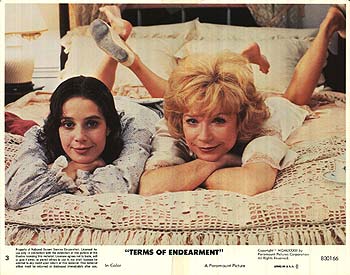 By contrast, the main Oscar winners from 1977 onwards were: the romantic comedy Annie Hall in 1977, the two relationship-focused Vietnam dramas Coming Home and The Deer Hunter in 1978, the family dramas Kramer vs. Kramer, Ordinary People and Terms of Endearment in 1979, 1980 and 1983, the historical dramas Chariots of Fire, Gandhi and Amadeus in 1981, 1982 and 1984, and the romantic historical drama Out of Africa in 1985. At the same time, there was – in comparison to the years before 1977 – an overall increase in the number of musicals, romantic comedies, family dramas and costume dramas among the annual top ten box office hits. Most (but not all) of these films had female stars receiving first or second billing, and there were even a few highly successful female ensemble pictures like Nine to Five (1980) and The Color Purple (1985).
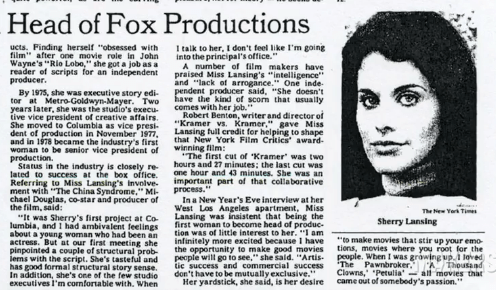
In this period, too, on the production side, Sherry Lansing, who rose higher than any other woman before within Hollywood’s studio hierarchies, was closely involved with Kramer vs. Kramer, the biggest hit of 1979 and a multiple-Oscar winner, almost completely sweeping the top categories; and Fatal Attraction, the second biggest hit of 1987 which received six Oscar nominations, almost all of them in the top categories. To what extent, then, was Hollywood’s reorientation driven by women in the film industry, like Lansing and Jane Fonda?
 The role of women in Hollywood since the 1960s has been the focus of several books, most notably Rachel Abramowitz’s Is That a Gun in Your Pocket? Women’s Experiences of Power in Hollywood (2000) and Mollie Gregory’s Women Who Run the Show: How a Brilliant and Creative New Generation of Women Stormed Hollywood (2002). These books outline the careers of large numbers of women ranging from producers and studio executives to actors and directors, discussing their basic approach to their work, major career decisions and their involvement with particular films.
These two books compare interestingly with Peter Biskind’s almost exclusively male-focused study Easy Riders, Raging Bulls: How the Sex-Drugs-and-Rock’n’Roll Generation Saved Hollywood (1998). Such a comparison suggests very strongly that, by and large in Hollywood, women on the production side relate very differently to female colleagues than men do to women, with an emphasis on support and fair competition rather than outright exploitation. They are more interested in female characters than men are and often aim to move them to the centre of their films. They highlight different qualities in their films. Linda Seger comments on her interviews with a wide range of Hollywood women: “Character, behaviour, emotions, and relationships are emphasised over and over again by women filmmakers.”[2]
Studies of women in Hollywood also provide…


 WFTHN
WFTHN 
Leave a reply to Hannah H Cancel reply