by Janet McCabe, Director of BIMI (Birkbeck Institute of the Moving Image)
What does it mean to recover a filmmaker who left almost nothing behind?
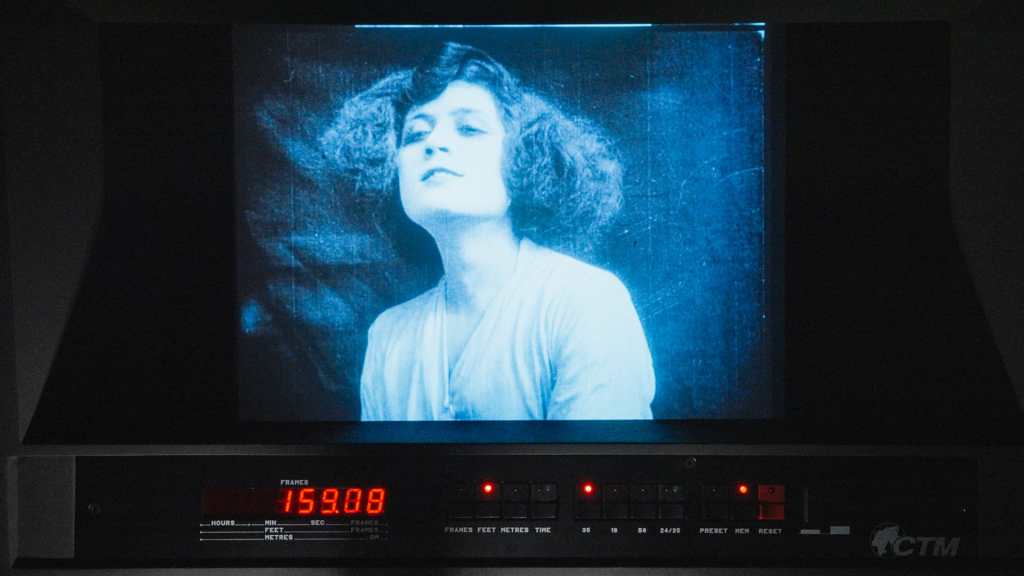
That was the question at the centre of Elvira Notari: Beyond Silence — a documentary about one of the most prolific female filmmakers of the silent era. Between 1906 and 1930, the Naples-born director, producer and studio founder made some 60 feature films — many hand-coloured — alongside 100 shorts and documentaries. Yet she and her work have remained barely visible. Only 163 minutes of film survive. No production records. No letters. No diaries.
A leading figure in the golden age of Neapolitan silent cinema, Notari wove the passions of popular melodrama with unflinching depictions of urban life, captivating audiences from Naples to the Little Italies of America. Undermined by Fascist censorship and family strife, she withdrew from filmmaking in 1930. Her name slipped into silence, and most of her work was lost.
Today, 150 years after her birth, Notari returns to centre stage — thanks to scholars reclaiming her place in history and artists revisiting her legacy through new forms. Interlacing historical memory with contemporary rediscovery, Elvira Notari: Beyond Silence offers a living, prismatic portrait of a cinematic pioneer whose vision continues to resonate today.
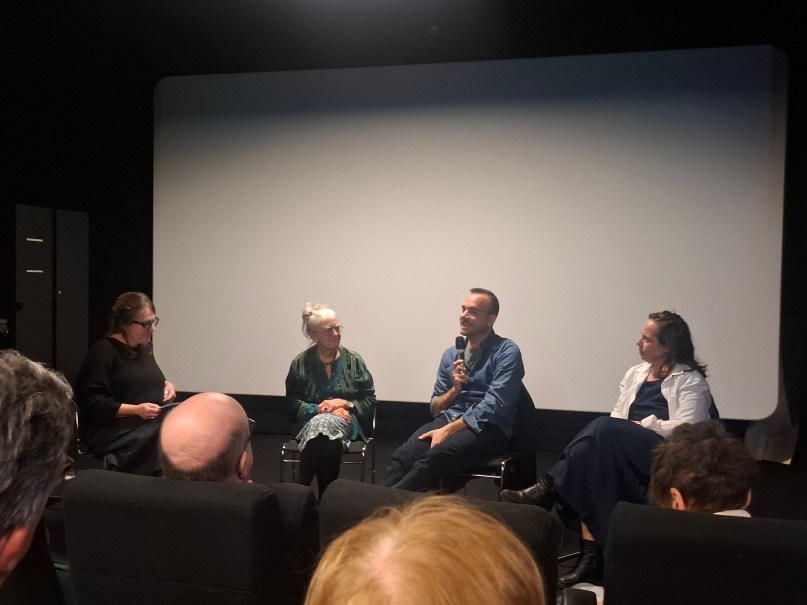
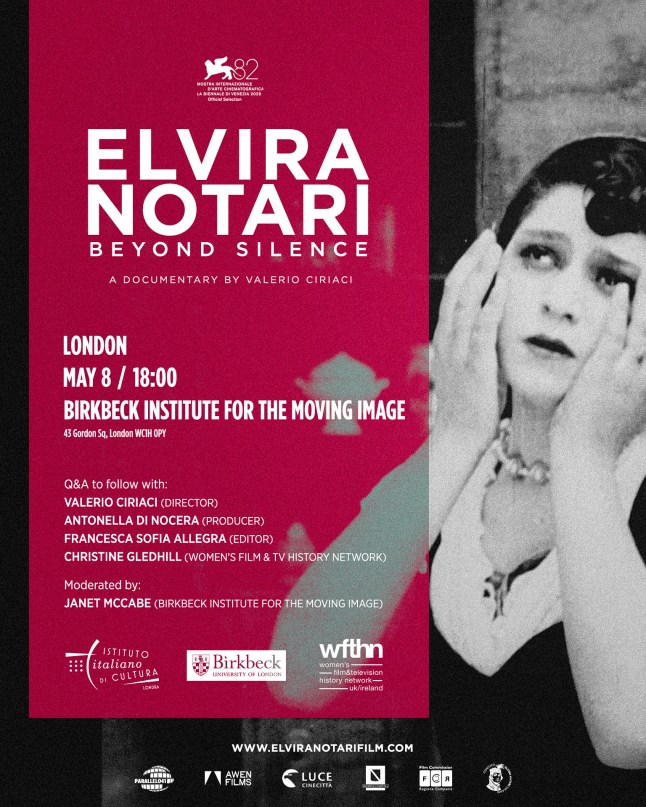
After the screening, I was joined in conversation by the film’s director, Valerio Ciriaci — Rome-born, New York-based documentary filmmaker and co-founder of Awen Films; the film’s producer, Antonella Di Nocera — Naples-based founder of Parallelo 41 Produzioni; and feminist film historian Christine Gledhill — Visiting Professor in Cinema Studies at Leeds University, co-founder of the Women’s Film and Television History Network UK/Ireland.
The conversation turned on three themes.
i. Absence
The film opens into silence. That absence is not incidental to the documentary. It is the film’s first argument. To sit with what is absent is to understand something about how the histories of figures like Notari are constructed, and for whom.
What strikes one about that absence is how complete it is. This is not a case of fragmented evidence or disputed attribution. It is more a systematic near-erasure: fascist censorship of Neapolitan culture; institutional neglect by historians and critics; an Italian film industry that was not, in the end, interested in giving space to a working-class woman making films for working-class audiences in Naples; and a family enterprise entangled with secrets and silence.
Valerio Ciriaci spoke of the challenge, as a documentary-maker, of finding a way of working that neither papers over these gaps nor is paralysed by them. The film assembles its sources — photographic fragments, family testimonies (often taken from the archive), the few surviving reels — and is honest about what they can and cannot tell us. But it does something more: it names the gap openly, as a condition of history rather than an obstacle to it.
ii. Recovery
The word ‘recovery’ can mislead. It implies that something is waiting to be found — intact, legible, available — if only we look hard enough. Notari’s case shows how rarely that is true.
What the documentary is doing, and what the panel discussed, is something more active: not recovery but reconstruction. And reconstruction involves choices. Whose voices carry the story? Which sources count as evidence? Where does Elvira Notari fit in the wider landscape of early women filmmakers — a ruined landscape that is itself still being pieced together?
These are not merely curatorial questions for archivists. A producer like Antonella Di Nocera — whose company has a long commitment to women directors and the female gaze — is confronted with funding questions, advocacy questions, and questions about what the industry is willing to support and what it continues to overlook. The film’s premiere at the 82nd Venice International Film Festival signals that overlooked figures in Italian film history are beginning to command serious institutional attention. It also represents the work of a producer negotiating with archives and stakeholders — historians, collectors, creatives, with ambitions for an exhibition in Naples planned for March 2027.
Christine Gledhill’s contribution to this thread was to reframe feminist film history as ‘active remaking’ rather than mere recovery. She invoked Jane Gaines and Monica Dall’Asta’s concept of constellation.1 Drawing on Walter Benjamin, this concept suggests that if we cannot bring back lost filmmakers, the objects they have left exist now in our present, creating a wedge in time through which past and present can meet in feminist film history.
Gaines and Dall’Asta propose that history is not a smooth continuum but a field of sudden, illuminating collisions — moments when a fragment of the past and a moment of the present flash into legibility together. Not causal, not chronological: a rupture, a recognition. This concept of constellation resists the logic of straightforward recovery, which assumes that lost women simply need to be found and slotted back into a corrected timeline. Instead, it asks how past and present charge each other — what a figure like Notari illuminates about now, and what now makes newly visible in her. The gap between past and present is not a problem to be overcome but a productive tension to be worked with. Central to this is the argument that every act of historical reproduction is a citation: a political and interpretive choice about what responds to our questions now and how. It is a method useful for exactly the kind of broken archive that Notari leaves behind.
iii. Legacy
This is where the project becomes, for me, most interesting — and most unusual as practice-as-research.
Elvira Notari: Beyond Silence does not treat its subject as a closed historical case. It treats Notari as an ongoing history. Running alongside the documentary is a body of work by contemporary artists — a photographer, a textile maker, a novelist, a composer, actors — each responding to Notari from their different disciplines. These creative impulses do not illustrate the film or decorate its argument. They are working from the same incomplete archive: the same silences, the same fragments, the same gaps. And they are making something from them.
The film seems to argue — and the panel found itself returning to this — that the line between recovery and reinvention is not a corruption of historical method. It may be intrinsic to it. Working in the gaps, openly, is more honest than pretending the gaps are not there. And the contemporary artists are not finishing something. They are continuing it.
What does it mean for a historical female figure like Elvira Notari to have a living legacy? Not one that is preserved behind glass, but one that is still being made? The answer this project offers is something like this: the figure of Notari remains generative. Her work — even in its absence — can still produce new work. She is not only an object of history but a presence within it. The creative workers who contribute to this documentary — the textile group embroidering screen prints of film stills, the novelist, and the photographer working with actors — adopt a distinct artisanal approach to making history, an artisanal aspect that, as Giuliana Bruno describes, Notari herself adopted, as does the film.2
Given the traditional marginalisation of Notari’s practices by archives as well as the documentary’s radical methods, the panel’s discussion raises the question: What counts as evidence? What counts as film history? If we expand our notion of what film history is — if we admit textile-making, photography, and fictionalising alongside retrieved film reels — we are not just adding new materials. We are changing the method.
The question I found myself left with is whether the conditions that produced Notari’s erasure are now genuinely changed, or whether we are still in a world that creates new Elvira Notaris — women making work for communities the industry is not interested in, in forms it does not recognise, in places it cannot see. The answer is probably both: things have changed, and not enough.
What I take from this evening is that Elvira Notari is not a recovery project with a completion date. She is something more like a practice — one that this film has renewed, and that the artists responding to it are extending.
Which seems right for a filmmaker who spent 30 years making work for communities that weren’t supposed to see themselves on screen. She understood, long before the industry caught up, that making images for people is a form of recognition. The project continuing around her name is, in its way, the same gesture returned to the present.
- Jane Gaines and Monica Dall’Asta. Prologue: Constellations: Past Meets Present in Feminist Film Histories,’ In: Christine Gledhill and Julia Knight (eds.), Doing Women’s Film History: Reframing Cinemas Past and Present. Urbana: University of Illinois, 2015: pp.13-25. ↩︎
- Giuliani Bruno, Streetwalking on a Ruined Map: Cultural Theory and the City Films of Elvira Notari. Princeton University Press, 1993: p.103. ↩︎

