by Peter Krämer
At the age of 43, Emily Blunt has reached another peak in her two-and-a-half-decade-long career with the back-to-back releases, in May and June 2026, of the comedy-drama sequel The Devil Wears Prada 2, for which she was billed third above the title, and Steven Spielberg’s science fiction thriller Disclosure Day, for which she got top billing.[1]
In addition to accolades for her performances, which might well result in her success at awards ceremonies early in 2027, The Devil Wears Prada 2 is likely to end up in the top ten of the global box office chart for 2026 (with an estimated box office total of around $700 million), and Disclosure Day might make it into the top twenty.[2] This is not just noteworthy in terms of Blunt’s career but also more generally: top-grossing films with a female lead are still quite rare (albeit not as rare as they were from the late 1960s to the mid-noughties),[3] and ones with three female leads (like The Devil Wears Prada 2) are almost unheard of.
An earlier peak in Emily Blunt’s career had been the release of Oppenheimer, the third biggest global box office hit of 2023, for which she received second billing and a ‘Best Supporting Actress’ Oscar nomination (as well as numerous other accolades). In the same year, she also garnered critical acclaim for her top-billed performance in the black Netflix comedy Pain Hustlers. Blunt was one of the film’s executive producers, which, as a whole, was not well received by critics – although I certainly liked it a lot.
Since being deeply moved by Blunt’s performance as Kitty Oppenheimer in 2023 (which I wrote about in a previous blog post), I have watched, or re-watched, many – but by no means all – of the over fifty films and television series she has appeared in since her screen debut (billed in third place) in the British TV movie Boudica in 2003.
There is so much to admire and enjoy in her work as a performer. She is extremely versatile, as good with emotional expressiveness (sometimes running the full gamut of expressions in a single film) as she is with physical action, including broad physical comedy. She can be extremely funny not only in her film roles but also in interviews, especially on television (where she has developed a reputation for her hilariously ‘unfiltered’ statements – or should I say that her statements often are comically ‘blunt’). Against the backdrop of her enormous overall likeability, she is willing to play (at least for long stretches in certain films) quite unlikeable, difficult, off-putting characters such as Emily Charlton in the Devil Wears Prada movies and Kitty Oppenheimer.
She is an accomplished singer and, yes, an iconic beauty. While sometimes referred to as an ‘English rose’, it has also been said (among others by her husband) that she has a ‘resting bitch face’, whereby in a relaxed, impassive state her face inadvertently gives the impression that she is annoyed, irritated or dismissive. This is connected to the fact that her resting facial expression includes a slight pout, which can read as anything from sulky to sexy. This makes it so much more striking when, as so often happens in her films and interviews, she bursts into a smile or laughter.
In addition, Blunt has an astonishing critical and commercial track record.[4] The former goes back all the way to her professional stage debut – she had previously starred in a student production of the rock musical Bliss at the Edinburgh Fringe Festival in 2000 – in a supporting role in Peter Hall’s West End production of The Royal Family in 2001, for which she was named ‘Best Newcomer’ by the London Evening Standard. Blunt’s commercial track record includes numerous global box office hits across an impressive range of genres.
What is more, Blunt’s career fits into the long tradition of British and Irish actresses having enormous success in Hollywood (a subject I have touched on in some of my previous blog posts here and here). Like many of her predecessors, she started in the theatre (from 2000 to 2002), worked in television (from 2003 to 2006, with occasional TV roles thereafter), made the transition to theatrical features in the UK (with the romantic drama My Summer of Love [2004]), started to appear in Hollywood movies (the first one being The Devil Wears Prada), went back and forth between (co-)lead and supporting roles before settling on the former (from 2008 onwards), eventually moved permanently to the United States (around the time she married the American actor and filmmaker John Krasinski in 2010) and became an American citizen (in 2015, without giving up her British citizenship).
Her screen performances have received numerous critical accolades, starting with her ‘Most Promising Newcomer’ win at the Evening Standard British Film Awards for her second-billed role in My Summer of Love, which also earned her nominations in this category at the British Independent Film Awards and from the London Film Critics’ Circle.
With The Devil Wears Prada, her acclaim as well as her audience reach went global. The Devil Wears Prada was the 12th-highest-grossing movie worldwide in 2006. Although Blunt was only billed fifth and below the title, in addition to various British nominations (including a win from the London Film Critics’ Circle) for this film, she received a Golden Globe nomination from the Hollywood Foreign Press Association for ‘Best Supporting Actress – Motion Picture’ (quite remarkably also winning the award for ‘Best Supporting Actress – Television’ for her role in the BBC drama Gideon’s Daughter). In addition, she was nominated in several categories at the MTV Movie & TV Awards and the Teen Choice Awards. Many more accolades followed in subsequent years for films in different genres.
After her initial specialisation in (mostly British) stage, TV and movie drama, both historical and contemporary, with a sideline in (musical) comedy, in 2007 Blunt began to branch out into other genres (without dropping the ones that had facilitated her rise to stardom; she continued to play quite a few British characters, and also an Irish one, in addition to all the Americans she now portrayed). This started with the low-budget supernatural horror movie Wind Chill (2007), which was a veritable star vehicle for her: on the poster, only her name is listed above the title. Wind Chill was followed by the big-budget gothic horror The Wolfman (2010), for which she was billed third, and the science fiction/horror Quiet Place franchise (in 2018 and 2020, she starred in two of the three films released so far, and will do so again in 2027).
In the early 2010s, she embarked on (non-horror) fantasy movies, starting with the live-action adventure Gulliver’s Travels (2010) and the animated romantic comedy musical Gnomeo & Juliet (2011). This was followed by the live-action fantasy musicals Into the Woods (2014) and Mary Poppins Returns (2018) as well as the fairy tale action film The Huntsman: Winter’s War (2016) and the fantastic action-adventure Jungle Cruise (2021), also by a string of animated (musical) features: Animal Crackers (2017), My Little Pony: The Movie (2017) and the Gnomeo & Juliet sequel Sherlock Gnomes (2018).
Blunt also became one of the most prominent women in contemporary science fiction, starting with The Adjustment Bureau (2011), followed by Looper (2012), The Edge of Tomorrow (2014), her two Quiet Place films and Disclosure Day. Extending the emphasis on action in some of her science fiction and fantasy films, she also co-starred in the action thriller Sicario (2015) and the action comedy The Fall Guy (2024).
A survey of numerous British, American and international acting awards reveals that Emily Blunt received considerable acclaim for many of her performances, and special praise for her work in nine films. These ranged from a low-budget British drama (My Summer of Love) and medium-budget British and American (comedy-)dramas (the Queen Victoria biopic The Young Victoria [2009], the bestseller adaptation The Girl on the Train [2016] and The Devil Wears Prada) via medium-budget science fiction/horror (Looper and A Quiet Place), to a big-budget musical sequel (Mary Poppins Returns), a big-budget biopic (Oppenheimer) and a mega-budget science fiction movie (Edge of Tomorrow).
Ten of the films (co-)starring Blunt made it into the top 35 of the annual global charts.[5] Reaching that tier means beating the vast majority of the thousands of films released into cinemas each year, including most of Hollywood’s output. When adjusting global box office revenues for ticket price inflation, we find that, in terms of cinema audience reach before 2026, Blunt’s most successful films were Oppenheimer, The Devil Wears Prada, Edge of Tomorrow (for which she received second billing) and two films for which she was billed first as their undisputed star attraction: Mary Poppins Returns and A Quiet Place.
Profitability is another matter. Half of a film’s global box office revenues stay with the movie theatres; the other half has to cover the expenses incurred by the production company and the distributor – and often does not do so. Half of those ten top 35 films, including all the big-budget productions apart from Oppenheimer, lost money during their theatrical release, in two cases well over $100 million. The low- to medium-budget films among those ten (with production costs of up to $60m) were reliably profitable, most notably A Quiet Place, which Blunt made with her husband.[6]
Blunt’s earnings from individual films (through up-front salaries and back-end deals, that is, a share of a film’s revenues or profits) have varied enormously, going as low as whatever money she received for the 2011 film Your Sister’s Sister, which had a reported production budget of only $120,000. Today, she is one of the highest-paid movie actresses in the world (getting in the region of $10-15 million per film), but she is still willing to work for much less (as in the case of the $4 million pay for Oppenheimer).[7]
Apparently, her biggest ever upfront salary has been the $15 million she received for Disclosure Day. The film was critically well-received, as evidenced, for example, by the 80% ‘fresh’ rating on Rotten Tomatoes. The website summarises the overall critical response (of hundreds of reviewers) as follows: ‘A humanistic variation on one of Steven Spielberg’s most revisited themes, Disclosure Day‘s breathless pursuit of optimism in an age of conspiracy gets its biggest boost from career-highlight work by Emily Blunt.’
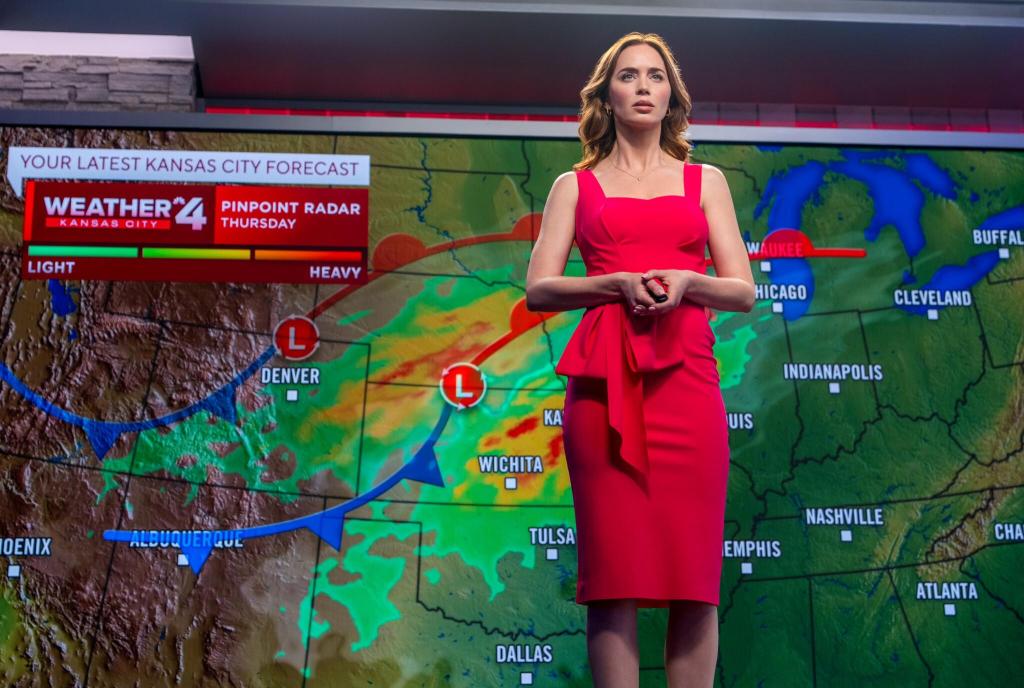
In fact, one might describe the story of Blunt’s character in the film – Margaret Fairchild, usually referred to as Maggie – in terms of a media career trajectory. She starts out as a rather stereotypical ‘weather girl’ at a local television station; while Maggie might not actually be referred to as a ‘weather girl’ (a somewhat dated, derogatory term) in the film, her tight, red dress and cheery flirtatiousness in front of the camera do evoke it. She becomes what one might call an inadvertent ‘disrupter’ when she starts making the clicking sounds of an alien language during one of her broadcasts, this scene then presumably being endlessly replayed on the internet and in social media.
Of course, Maggie wants to be a ‘real’ journalist, and, as it happens, she stumbles on arguably the biggest news story ever. Furthermore, she gets to present it herself not only on local TV but in what grows into a global broadcast. In one stroke, she becomes the most famous media personality on the whole planet.
Her news report is a revelation (and not just in a journalistic sense) of what had long been concealed, and this revelation appears to pull humanity back from the brink of World War III. After exposing evidence of human contact with extra-terrestrials which had previously been kept from the public, Maggie also becomes the mouthpiece of a non-human, quite possibly super-human, entity originating in the heavens above Earth: she is given a message by an alien which she then is going to relay to all of humanity – in a close shot she looks directly at the camera and says ‘Listen’, at which point the film cuts to black. I agree with several commentators who have described Maggie at the end of the film as a ‘messiah’ – although, unlike those who label her a ‘cosmic messiah’, I would want to call her an ‘American’ one.
The story of Disclosure Day is so focused on American history and characters – from the Roswell incident of 1947 via the formation of Wardex in 1973, to the present-day operations of this mysterious American organisation. While there are numerous references to global political and military crises, all the important events that will eventually resolve them (or so it seems) happen in the United States. They include the aliens’ selection and upgrading (?) of two individuals during their childhood and their later activation (?) so that they can play their parts in a joint alien/human plan to reveal the truth to the world – through a Kansas City television station no less.[8]
Blunt has received a lot of praise for the range of (regional) American as well as English accents she has adopted in many of her roles. In Disclosure Day, she goes further by switching smoothly from English to Russian and Korean; the actress also insisted on producing the sounds of the alien language coming out of her mouth on her own (rather than having them created digitally). One might also say that, in addition to this linguistic tour de force, the film moves her through a range of generic frameworks and associated character types (which in turn reflect the range of genres and roles of her preceding career): a television presenter in what, in a different filmic context, one might have expected to turn into a (romantic) workplace comedy; an apparently somewhat frustrated wife in a marriage dramedy; a possessed woman in a horror movie; a person with very special gifts in a spiritual/religious drama or a superhero movie; a very resourceful protagonist on the run in an action thriller; etc.
Disclosure Day’s alien-encounter storyline has particularly strong resonances across Blunt’s earlier career. In three of her most successful films – Edge of Tomorrow and the two Quiet Place movies – she has fought aliens. This makes her Disclosure Day role as a mediator/medium, aiming to bring peace not only among humans but also between humans and extraterrestrials, a particularly striking departure from the norm of alien invasion movies. This departure is, of course, perfectly in line with Spielberg’s previous work on Close Encounters of the Third Kind (1977) and E.T. the Extra-Terrestrial (1982). In effect, Margaret Fairchild (and through her, Emily Blunt) walks in the footsteps of Roy Neary and Claude Lacombe, Elliott and Keyes – and, unlike them, she transforms the whole world in doing so.
[1] I emphasise Blunt’s age because 40 has long been seen as a cut-off point for the careers of leading ladies, but this barrier has certainly been overcome in recent years, as I have tried to demonstrate in a previous blog post. Information about Blunt’s billing is relevant because it indicates how important she was to the marketing of the film in question and, usually, to its story.
[2] Cp. the current global box office chart at https://www.boxofficemojo.com/year/world/2026/. All the websites referenced in this blog post were last accessed on 25 June 2026.
[3] Cp. Peter Krämer, ‘The Recent Success of Franchise Queens and Other Female Action Stars Over 40‘; and Peter Krämer, ‘”The Girl on Fire’: Children’s Fiction, Female Stars and Contemporary Hollywood Blockbusters’ (Parts 1 and 2).
[4] I have used various websites to check her commercial and critical track record, most notably Box Office Mojo and https://en.wikipedia.org/wiki/List_of_awards_and_nominations_received_by_Emily_Blunt.
[5] These films are: The Devil Wears Prada (no. 12 in the global chart for 2006), Gulliver’s Travels (no. 30 in 2010), Gnomeo & Juliet (no. 35 in 2011), Edge of Tomorrow (no. 20 in 2014), Mary Poppins Returns (no. 31 in 2018), A Quiet Place (no. 32 in 2018), A Quiet Place Part II (no. 15 in 2021), Jungle Cruise (no. 19 in 2021), Oppenheimer (no. 3 in 2023) and The Fall Guy (no. 33 in 2024).
[6] Among films (co-)starring Blunt that did not make it into the annual global top 35, Looper made a profit of around $45 million during its theatrical release, while The Wolfman lost well over $100 million.
[7] Most of the information in this paragraph is taken from Laura Rodini, ‘Emily Blunt’s net worth in 2026: A look inside the Disclosure Day star’s wealth’, TheStreet, 11 June 2026 https://www.thestreet.com/personalities/emily-blunt-net-worth. According to this article, currently the combined net worth of Blunt and her husband is estimated to be $100 million.
[8] Oddly enough, despite this almost exclusive focus on the United States, almost all of the main characters – Maggie, her male counterpart Daniel Kellner (Josh O’Connor), his girlfriend Jane (Eve Hewson) and the head of Wardex, Scanlon (Colin Firth) – are played by British and Irish actors.
Peter Krämer is an Honorary Senior Research Fellow in the Faculty of Technology, Arts and Culture at De Montfort University (Leicester, UK). He is also an Honorary Fellow in the School of Media, Language and Communication Studies at the University of East Anglia (Norwich, UK) and a regular guest lecturer at several other universities in the UK, Germany and the Czech Republic. He is the author or editor of twelve academic books, including American Graffiti: George Lucas, the New Hollywood and the Baby Boom Generation (Routledge, 2023). For many years, he has published on and taught courses about the role of women in Hollywood (both on- and off-screen).

